


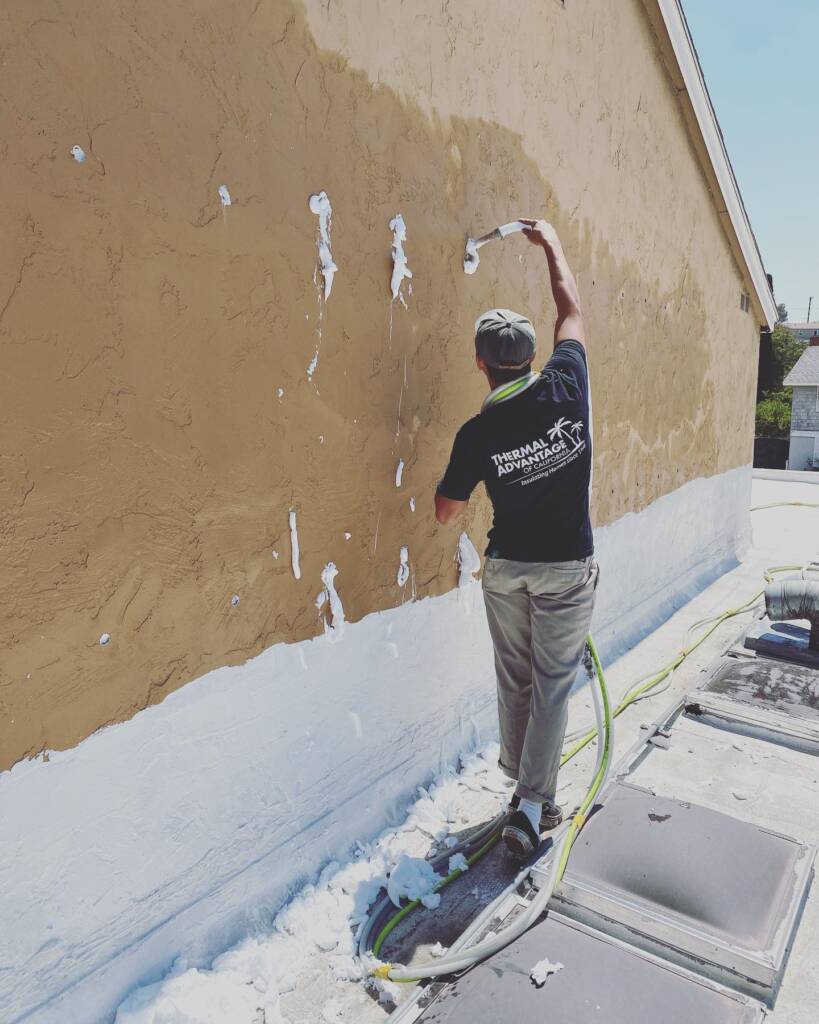
Most homes built in Southern California before the late 1970s went up with little or no insulation in the walls. Fixing that used to mean tearing out drywall or stucco. It doesn’t anymore.
Thermal Advantage of California insulates existing walls by injecting foam into the empty cavities through small access holes, then patching the holes. Your walls stay where they are. We work on homes across San Diego County, Orange County and Riverside County, and injection foam for existing walls is the only thing we do.
What is injection foam insulation?
Injection foam is a low-density foam that is pumped into a closed wall cavity as a thick, shaving-cream-like material. It flows around wiring, pipes and framing, fills the space between the studs, and then sets in place.
It is a different product from spray foam. Spray foam is applied to open, exposed surfaces during construction or a gut remodel. Injection foam is made for walls that are already finished, which is exactly the situation most homeowners are in.
The product we install is InsulSmart MH, made by cfiFOAM. The manufacturer describes it as a hybrid resin foam that is not urea-formaldehyde based, formulated for states such as California where urea-formaldehyde foams are restricted. You can read the manufacturer’s product page and its guide specification for yourself.
How the installation works
1. We check your walls. Before anything else, we confirm what is inside the wall cavities and whether the walls are a good candidate. Walls that already hold insulation, or that have a moisture problem, need a different conversation.
2. We drill small access holes. Holes go into each stud bay, usually from the exterior of the home.
3. We inject the foam. The foam is pumped into each cavity until it is full. Because it goes in as a flowing material, it works its way around obstructions that would stop a batt or leave gaps.
4. We plug and patch. Each hole is plugged and patched so the wall is closed up again.
Many homes are finished in a day, with the work done from outside and no crew working through your living space.
What insulated walls do for a home
Steadier indoor temperatures. Exterior walls are a large share of the surface between your rooms and the weather. Empty cavities let heat pass through. Filling them slows that heat transfer, which helps rooms hold their temperature through hot afternoons and cool nights.
Less work for your heating and cooling. When walls slow heat transfer, your system has less to make up for. How much that shows up on a bill depends on the house, the equipment and how you use it, so we don’t quote a savings percentage. We will tell you plainly what we see in your walls and what filling them is likely to change.
Less outside noise. An empty wall cavity gives sound an easy path. Filling it can help reduce the traffic and neighborhood noise that reaches your rooms. It will not make a home silent, since windows and doors carry a lot of sound too. More on that in our guide to wall insulation and noise.
No demolition. The drywall, plaster and stucco stay. The work is access holes and patches, not a remodel.
The numbers, from the manufacturer
We only publish performance figures we can point to a source for.
| Property | Manufacturer’s published figure | Source |
|---|---|---|
| Thermal resistance | R-4.6 per inch at 75°F | cfiFOAM guide specification |
| Surface burning (ASTM E-84) | Flame spread under 25, smoke developed under 450 | cfiFOAM guide specification |
| Shrinkage as it cures | Typically 0.5% | cfiFOAM guide specification |
These are the manufacturer’s figures for the product, not a measurement of your finished wall. Wall performance also depends on framing, windows, and how well the rest of the house is sealed.
Is your home a good fit?
Injection foam is a strong fit when:
- The home was built before modern energy codes and the wall cavities are empty. California’s building energy standards first took effect in 1978, so many older homes were built without wall insulation.
- Certain rooms run noticeably hotter or colder than the rest of the house.
- You want better walls without opening them up.
It may not be the right fix when:
- The walls are already full of insulation in good condition.
- There is an active leak or moisture problem in the wall. That has to be repaired first.
- The home has old knob-and-tube wiring that is still live. An electrician should evaluate it before any wall insulation goes in.
Not sure which camp you are in? Our guide on homes with no insulation in the walls explains how to check.
What we don’t do
We are not a general insulation company. We don’t install attic insulation, fiberglass batts, blown-in insulation, spray foam, radiant barriers or crawlspace insulation. If your home needs one of those, we will say so and you can hire the right contractor for it. Existing walls are our whole job.
Frequently asked questions
Can you insulate walls without removing drywall? Yes. Injection foam goes in through small access holes that are patched afterward. See how to insulate existing walls without removing drywall for the other options and how they compare.
How is injection foam different from spray foam? Spray foam is sprayed onto open surfaces and needs the wall cavity exposed. Injection foam is pumped into closed cavities. We compare the two, plus blown-in insulation, here.
What is the R-value? The manufacturer publishes R-4.6 per inch at 75°F for InsulSmart MH.
Will it make my house soundproof? No, and be wary of anyone who promises that. It can help reduce noise coming through the walls.
Where do you work? San Diego County, Orange County and Riverside County. See our San Diego, Orange County and Riverside pages.
Are you licensed? Yes. California contractor license #1126284.
Find out what’s in your walls
Tell us about your home and we’ll tell you whether injection foam makes sense for it.
